I Promise You Won't Learn A Thing From This Blog

The official blog for author Ashley Chappell. Check back every week for a few laughs at my expense or, if you know the love-hate process that is writing, commiseration.


Showing posts with label Language. Show all posts

Thursday, May 24, 2012

Why I Love This Crazy Language


Captain Caveman
Captain Caaaave Maaaan!
It occurred to me this week that I’ve written many times lately about grammar misuse in a very negative light, basically bashing the grammar-challenged over the head with a blunt blogject. It further occurs to me that this maaaaaaaay not be the best way to lure the on-the-fencers away from the dark side that is grammarcide.


So I’ve decided to take another approach and make today’s post about why I love this kooky language of ours so much. Hopefully by the end of this piece my lovely readers will understand that my bashing of bad grammar isn’t purely out of snobbery; it’s out of an earnest desire to preserve the richness and the meaningful structure of the language. If anything, I’m a mama bear protecting her favorite cubs.

I’ll start with an example from one of my favorite authors. I love, love, love, love LOVE Isaac Asimov (Did I mention that I love him?), not for his prose, but for his story-telling, suspense-building, and his sharp analytic mind. Reading his robot novels is a master class in science fiction and analytics all in one. Last week I was reading The Robots of Dawn and came across a passage where Elijah Baley, our hero, was trying to explain the difference between the words ‘homicide’ and ‘murder’ to a robot. By definition these two words are the same and so the robot makes no distinction, but Baley has to try to explain why a human would scream ‘Murder!’ rather than ‘Homicide!’ when witnessing the act.

And why is that?

Those two synonymous words, like so many so many in our language, have evolved their own emotional value through usage, through cultural development, and through association. At some early point people may not have made any distinction between the two, but now we reserve the word homicide for describing the legal nature of the act, and murder for the emotionally charged, teeth-clenching, fear-inspiring nature of the act.

Now think of some other similar words from a writer’s POV. This is where my love of our fantastically diverse and complex language comes into play; when it comes to the thesaurus I’m like a kid at the world’s most gigantic and nerdy vending machine. For fun, I’m including a short list of other synonyms without a definable distinction. Take a look at these and think about the way they make you feel; if you use one instead of the other in a sentence, does it change the image you want to convey?

Worried, Apprehensive, Fraught
Weak, Frail, Spineless
Hungry, Famished, Ravenous
Fat, Obese, Beefy
Smile, Grin, Leer
Arrive, Appear, Pop-in
Surprise, Overwhelm, Dumbfound
Real, Solid, Absolute

Some of these are more subtle than others, but they are still the key device in the writer’s tool box and the most important part of the picture we want the reader to paint for themselves. What are your favorite synonyms to add to this list?

Thursday, May 17, 2012

Swashbuckling Grammar Pirate


Grammar Ninja Today’s blog might be the most important blog I have ever written. I have decided, after yet another blunder today, that I must share the annoying information in my head or suffer blow after blow to my own sanity for the rest of my natural tenure on this world as a Grammar Nazi Avenger (yeah, I’d like to see Marvel take that one on, too).

The Set Up: All names and identifying references have been changed to protect the innocent. Though, mind you, they were NOT innocent of committing accidental grammar-cide.

Person chatting in my office: “Oh, I always have someone else do that. Caulking isn’t really my forté.”
Me, sitting in my chair and cringing: “Um, you know, that word actually... oh, nevermind.”

Anatomy of a sword
The Anatomy of a Sword
What you have just witnessed is a shortened version of a very complex mental train-wreck of thought. As I heard the last word in her sentence pronounced as the oh-so-common two syllables, what I wanted to say was this (picture me in a tweed professorial jacket as I speak deferentially of etymology and linguistics):


“You know, what you have stumbled upon is actually a very common and interesting mispronunciation of the word ‘forte.’ You see, it all stems from a misunderstanding of the obscure French origin of the word in this use in combination with the much more frequently seen Italian musical term of the same spelling. Indeed even more so due to the somewhat synonymous meaning of the words. When you intend to use the word as a description of your strengths you are actually invoking a French fencing reference that describes the strongest point of a sword: the ‘forte,’ (pronounced like ‘fort’). Weaknesses similarly are described using the word for the weakest point of the sword: the ‘foible.’ Therefore, fortes and foibles = strengths and weaknesses. The Italian version, pronounced ‘fortay,’ is the musical reference for playing loudly or strongly, thereby explaining the confusion especially among people with a musical background. It's really quite amusing, isn't it? I said isn't it?”

I’m sure it doesn’t take much imagination to envision the blank and/or glazed looks I would get had I actually let that come out of my mouth. Hence the abbreviated version that started with ‘Um’ and ended with ‘nevermind.’ And because this pronunciation of the word is so very common, if I try to use the term correctly people give me that smug look that is tantamount to pointing fingers and laughing that the grammar nazi got something wrong. Either they try to correct me, at which point I have to go into the long explanation given above and the glaze goes over the eyes, or they just sit there looking smug, at which point I FEEL like I have to go into the long explanation given above and the glaze goes over the eyes.

So, over time, I have just made myself avoid using this term at all and even make myself choke back the lofty correction I so yearn to deliver. The phase “Blank is/is not my forte’ has been forever lost to my conversational repertoire, and sometimes I do lament its passing while cursing the English teacher who pointed this out to me in high school. Perhaps this is one case where ignorance might have been bliss.

The First Fist Pump
The First Fist Pump Ever.

The Solution:

And this is where I decide that constantly ignoring this abuse of language is just as bad as condoning it (not to mention that I selfishly just want to be able to use this phrase again without entering into the above conflict). To kick off this campaign which I shall code name "May The 'Forte' Be With You", I have shared this knowledge with you, my lovely readers and fellow writers and language lovers, in the hope that you will all go forth and spread the word, educating the masses and freeing me from my vocabulary paralysis.

If we put our minds to it, together WE CAN TAKE BACK THE FORTE!!!!!!!!

Until then, my friends, May The 'Forte' Be With You.'

Thursday, March 01, 2012

You're in Trouble Now... She's Being Polite!

Don't Care
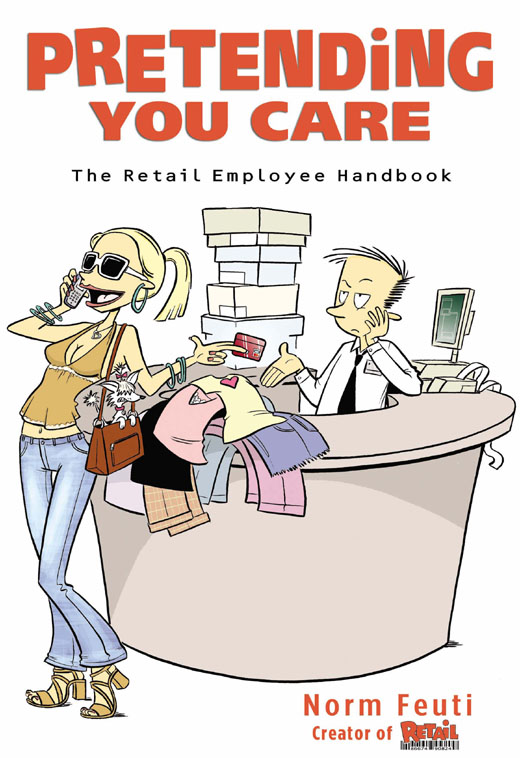
All Customer Service Employees need this book
Yes, I'm trying to stir the pot again.

I made the following statement on Facebook this week to see what reactions people would have: “There is a vast difference between being 'nice' and being 'polite.’” A few people, and I have to believe that they are among those rarities who are actually nice all of the time (yes, they do exist but I am unfortunately not one of them), argued that there is no difference between the two words. For most of the discussion, however, I found that people do tend to notice distinct differences between these two words and what they meant to them.

I bring this up for two reasons: 1) Being a word nerd, I’m fascinated by how two words meaning essentially the same thing conversationally (despite specific definitions) and used interchangeably so often can evolve to conjure such specific reactions, and 2) I realized that the ‘polite’ person that I was talking to on the phone was not a ‘nice’ person at all. In fact, I was pretty sure that she was giving me the finger while she was saying, “Bless your heart,” safely from her end of the phone line.

Old lady
You probably grew up across the street from this lady


For those not familiar with southern sarcasm, ‘Bless your heart’ can sometimes be a meaningful expression of sympathy, but more often than not it’s a southern lady’s socially acceptable way of saying “Why the hell do you think I care?”


Now I’m wondering about my own responses to people and feeling slightly guilty. You know what I mean... The phone rings at work and, blast that caller ID, it’s one of those people you'd rather give extraneous body parts than have to deal with. But, since you have a job to do for which you are being paid, on goes that plasticine smile with the glazed eyes as you say, “No, you’re no problem at all, really, how can I help you?” All the while your imagination is dreaming up scenarios in which it would be acceptable for you to scream “Go away already you horrible person!”

See? Polite, but not nice.

Now that I’ve given you the set up, what do you think? What do these two words mean to you? 


Tuesday, February 21, 2012

A little mid-week treat...

Yes, I know it's not Thursday yet, but this was too near and dear to my heart to not share. I feel this way Every. Day. And though I don't mean to be a grammar snob, I do at least have the courtesy to wait until the offender has left before commencing the merciless  ridicule (though trite and self-serving it is).

Owly Images
Now go forth and sin no more

For my friends who also suffer from this malady: Benadryl just won't cut it for this one. But this will.

Happy editing!

Thursday, February 09, 2012

Why You Should Send Hate Mail to Dictionary Editors


As I develop my blogging skills and decide what subjects to tackle each week, I’m noticing that my blogs tend to be largely reactionary for the most part. Whether serious or tongue-in-cheek, so far I’ve blogged for the following reasons:

1.      To vent.
2.      To revel in irony.
3.      To poke fun at some quirk of my own or of humanity in general.
4.      Some combination of all of the above.
5.      To share stories in writing, or solicit feedback to help me improve.

So far, those 5 pretty much sum up the contents of my blog to date. Now I’m going to add a glorious 6th motivation for blogging:

6.      To keep from cringing in front of someone at their poor grammar.

Everyone needs an outlet. And today when I heard the phrase ‘A whole nother’ for the third time, I knew I needed that outlet ASAP. This is a phrase that I hear pretty often since moving to the beautiful state of Alabama (Note: That was not tongue-in-cheek. I genuinely love this state) and it seems to be pretty prolific throughout the Huntsville area, though I can’t say I recall ever hearing it before I moved here five years ago. Each time I’ve heard it I cringed inwardly and fought the response that was just begging to escape...

I want to roar: “THAT’S NOT A FREAKIN’ WORD!” ‘Nother,’ they say. Not ‘another.’ Not ‘a whole other’ as would be the correct phrase here. Or, I’d even give a person liberty with ‘A-whole-nother’ if they wanted to put it in writing. I kind of have to allow that considering the numerous liberties I take with hyphenated word creation when vocabulary fails me. And while I’m the first to admit that I’m a complete grammar snob, this is always one phrase that grates on me in particular.

So I decided to write a blog about it. And to be especially snarky and smartass, I thought I’d make a point of looking in the dictionary and symbolically pointing to the big blank place where ‘nother’ would be entered if it were an actual word and not some corruption of speech... And this is where Mssrs. Merriam and Webster failed me. In fact, I would even go so far as to embrace the meme and call it an Epic Fail.

‘Nother’ now has an entry. Granted, it’s listed as informal usage in speech, but simply having that slot in the holy book of all that is language legitimizes it while at the same time dropping the English language one rung farther down the ladder of bastardization. As a logophile, I feel utterly cheated. In fact, I’m frightened to live in a world where instead of publicly flogging those who use words that don’t exist, we add those words to the dictionary! But I suppose it’s probably easier in the long run to recognize poor grammar as language rather than hiring a squad of grammar police armed with dictionaries and parse trees to enforce lexiconian (yes, I just made up that word) law (and yes, it should be law).

I know my chances are pretty good of hearing this phrase at least once more today and I know that when I do I will still cringe internally and fight the urge to correct the perpetrator. But knowing that the lords of the dictionary have now deigned to embrace ‘nother’ into the realm of language, my typical internal roar will be little more than a futile mew: “THAT’S NOT A FREAKIN’ WORD!”  I’ll think meekly, knowing that in this argument my legs have been cut out from under me because now someone can look up the offending word and say, “But it’s in the dictionary!”

Once upon a time, words had value, they had meaning, and even the ability to use them correctly was a thing of value and pride itself. But once the words that are used incorrectly make their way into the dictionary as language, well, that’s a whole ‘nother’ ball game.